Repatriation of Funds - How Can NRIs Pay for Property Purchase in India?
Are you an NRI who recently finalised a residential apartment in India? But the builder’s question over payment mode turned the overwhelming emotion into anxiety? Can I pay full payment in cash, or will partial cash and online payment work? If these questions are giving you sleepless nights, then read this NRI Buyer’s Guide. It has everything NRI investors need to know about transactional options for buying a property in India.
Let's say you bought a 3BHK in Sector 150, Noida for ₹1.8 crore. The sales representative is in touch with you. The family back home is busy preparing to move in, but you have a bigger question in mind. How to pay for the property purchase in India via foreign currency? How to legally transfer payment from a Canadian bank account to the builder’s account in India? How to save tax on a high-value monetary transaction from a foreign bank to an Indian bank?
These questions come to mind after signing the booking form. Read this guide to understand every legal check smoothly to own a property back home.
What is Repatriation of Funds?
Repatriation of funds simply means transferring money you've earned or received in a foreign country back to India through legal banking channels.
It's regulated by FEMA (Foreign Exchange Management Act, 1999). It is a different body from the RBI (Reserve Bank of India) to curtail money inflow into the country via wrong routes.
The money has to initially transferred to an Indian bank account — An NRO account (for rupee earnings like a property sale) or an NRE/FCNR account (for funds originally brought in from abroad) has to be set up before making payment for the purchased property.
Payment limits on the source of funds
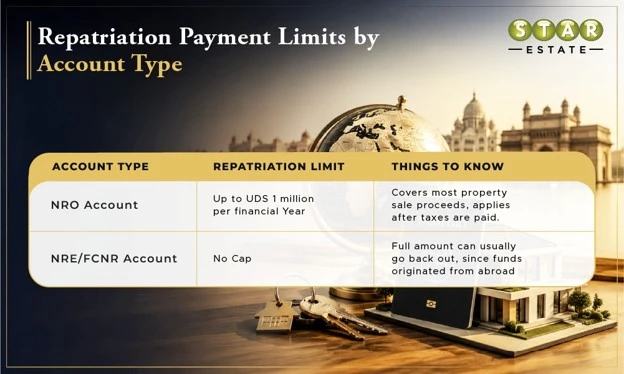
According to Indian laws, an NRI individual has a limit for money transfers. Such as,
Up to USD 1 million per financial year from an NRO account (covers most property sale proceeds), after taxes are paid.
No cap if the original purchase was funded through an NRE or FCNR account — the full amount can usually go back out.
Capital gains tax (or applicable TDS) must be settled before the remaining "net" amount is repatriable.
Documentation matters — Banks typically need Form 15CA/15CB (tax compliance certificates), a sale deed, and KYC records before processing the transfer.
How can NRIs legally pay for a Property Purchase in India?
The legal way for sending money to India for property buying starts with the FEMA guidelines. FEMA (Foreign Exchange Management Act) permits an NRI or PIO to pay for Indian property only through funds remitted to India via banking channels. Otherwise, via funds already available in an NRE, FCNR (B), or NRO account. Any payment via traveller's cheque, foreign currency notes, or any transaction routed outside India stands invalid.
Therefore, repatriation of funds to India for Property Purchase is possible via -
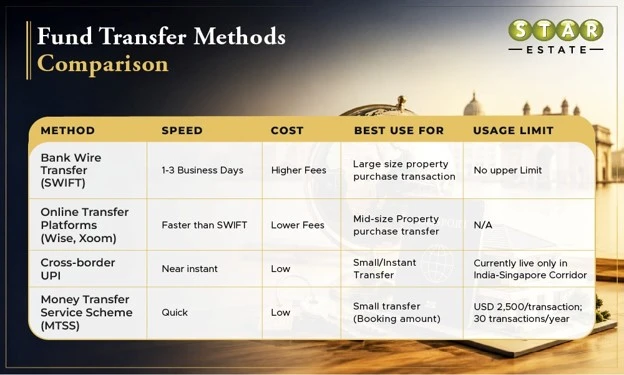
Bank wire transfer (SWIFT): It is the first option to pay for a property purchase transaction. It is highly secure and has no upper limit. It usually takes one to three business days and carries higher fees than digital alternatives.
Online money transfer platforms: Services like Wise offer transparent, mid-market exchange rates, while providers like Xoom process transfers faster. They have lower fees than a traditional wire.
Cross-border UPI: NPCI International has enabled UPI-based cross-border payments. Currently live on the India–Singapore corridor, allowing NRIs to send money straight to an Indian bank account or UPI handle.
Money Transfer Service Scheme (MTSS): It is feasible for smaller amounts, capped at USD 2,500 per transaction and 30 transactions a year. It is suitable for small amounts, like the booking amount for the property.
For anything beyond the token amount, the wire transfer or a reputable online remittance platform, credited directly into your NRE, NRO, or FCNR account (or the builder's account with the correct purpose code), is where almost every serious NRI transaction ends up.
Know What Your Bank Checks before Clearing a Repatriation
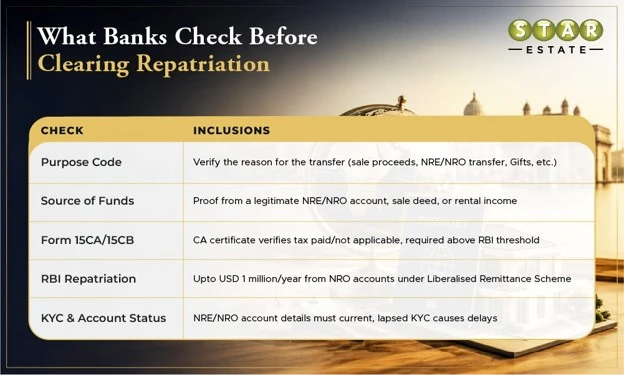
Before a bank clears repatriated funds, it needs a valid purpose code. It is a short tag confirming the reason for the money transfer. It’s for sale proceeds from property, an NRE/NRO fund transfer, or gifting to family.
The bank will flag the transaction for clarification. It can turn a single-day process into a mail trail for a couple of days. While the builder back home awaits payment transfer.
How to Fix – Inform the bank about the actual purpose of the money transfer every time you make a transaction. A few things banks typically verify alongside the purpose code:
Source of funds — Proof that the money came from a legitimate NRE/NRO account, sale deed, or rental income, not an unverifiable cash source.
Form 15CA/15CB — A chartered accountant's certificate confirming that tax has been paid or isn't applicable is required for most repatriations above the threshold set by the RBI.
RBI repatriation limits — Under the Liberalised Remittance Scheme, individuals can repatriate up to USD 1 million per financial year from NRO accounts, subject to conditions.
KYC and account status — Your NRE/NRO account details must be current; a lapsed KYC is one of the most common (and avoidable) reasons for a hold-up.
Sorting these out before you initiate the transfer is what separates a smooth repatriation from a challenging one.
Change in Rules for NRI Fund Repatriation Property Buyer Must Know in 2026
If you bought property before 2025, there's a rule change worth knowing before your next purchase. The RBI's FEMA amendment mandates stricter reporting of cross-border property transactions through the Single Master Form on the RBI's FIRMS portal, and NRIs now need to update their property purchase or sale details within 30 days of the transaction.
The missed timeline creates a compliance gap that has nothing to do with the builder, the title, or the money itself. It is thus insufficient paperwork and is avoidable if you have a CA by your side.
Things to Check for NRI Investors before making Payment to Buy a Flat in India
Verify RERA Registration - Always verify a project's RERA ID on the respective state's RERA website before making any payment. It takes five minutes, and it's the single highest-leverage check you can make.
Confirm Escrow Account - RERA mandates that a portion of buyer payments be held in an escrow account tied to construction milestones — ask the builder to show you this in writing, not just describe it.
Check for Property Title Search - RERA registration does not verify the developer's title to the land. Unclear ownership and unregistered transfers remain the leading cause of litigation for NRI buyers. Check for clear property title, also you can hire a counsel to verify it personally.
Check Seller’s Nationality – It is an important thing to check for NRI property buyers in India. If you're buying a resale property from an NRI seller, TDS is 12.5% plus surcharge and cess — not the 1% rate that applies when buying from a resident Indian — and that responsibility falls on you, the buyer, not the seller.
Ask for Occupancy Certificate in case of ready-to-move Property -For RERA-registered projects, builders are required to upload the Occupancy Certificate on the project page — check it online before you finalise the deal.
Zero Cash Transaction - Payments must go through banking channels — direct transfers, demand drafts, or cheques; cash transactions are prohibited under both FEMA and Income Tax rules — however small the "convenience" payment being requested might seem.
Check PoA if you are unavailable for Property Registration - A notarised, apostilled PoA executed correctly abroad saves you a flight back to India just to sign at the sub-registrar's office.
Why it is the Right Time for NRIs to Buy Property in India
With the rupee trading above the 90-to-a-dollar mark through 2026, the same ₹1.8 crore flat in Noida costs a Toronto-based buyer meaningfully less in Canadian dollars than it would have three or four years ago.
Combine that with 78% of NRIs in a recent ANAROCK survey ranking Indian real estate as their top investment choice. Therefore, it is clear why NCR corridors like Sector 150 Noida, the Noida-Greater Noida Expressway, and Golf Course Extension Road in Gurugram continue to see steady NRI-led demand.
Why Choose Star Estate for Buying Property in India
Star Estate has a verified RERA agent number. We work with RERA-registered developers across the country. Also, a thorough check for RERA registration, escrow compliance, and title clarity on every project we recommend to NRI buyers.
Talk to a Star Estate advisor before you finalise payment, as it saves you from legal hassle.