30 Days to Settle: What MahaRERA's Faster Conciliation Bench Means for Homebuyers
The Maharashtra Real Estate Regulatory Authority (MahaRERA) has just halved the time its Conciliation Bench gets to settle disputes, and it is the biggest real estate news for Maharashtra homebuyers this month. Instead of up to 90 days after the first hearing, the bench now has 30 days.
Imagine you booked a flat in 2022, possession was due last year, and every email to the builder ends in silence. Do you wait years for a full hearing, or try to settle it in a few weeks? That is the choice this circular puts in front of homebuyers.
In this blog, we explain what changed, what it means for buyers in Mumbai, Pune, and beyond, and the fine print: the consent catch, the missing extension, and how to prepare for a conciliation face-off.
AI Powered Summary
MahaRERA has halved its conciliation window: homebuyer–developer disputes must now be settled within 30 days of the first hearing.
Circular 38A/2026, dated 5th November 2026, cuts the Conciliation Bench's post-hearing window from 60 days to 30. The earlier 30-day extension, which allowed up to 90 days in total, is not mentioned in reports on the new rules.
The first hearing must still be fixed within 15 days of assignment. End to end that means roughly 45 days instead of up to 105.
The clock only runs if the developer agrees to conciliation, which is the part headlines might skip.
There is no separate conciliator fee when MahaRERA refers the matter, and a recorded settlement is enforceable.
Preparation now matters more than patience, so arrive with documents, a clear demand and a fall back plan.
MahaRERA Conciliation in Maharashtra: What Changed in 2026
MahaRERA's Circular 38A/2026, dated 5th November 2026, gives the Conciliation Bench 30 days after the first hearing to settle a homebuyer–developer dispute, down from 60 days. The first hearing must still be fixed within 15 days of a complaint being assigned. It covers complaints referred after that date.
How the Old 60-Day Rule Worked
Under Circular 38/2021, issued in November 2021, the bench had to finish conciliation within 60 days of the first hearing. If a settlement was close but needed more time, it could take up to 30 more days after informing the MahaRERA Secretary. Matters that ended as settled or failed went back to MahaRERA within a week.
What the New Circular Says
The new circular keeps the 15-day window to the first hearing but shortens everything after it to 30 days. Industry reports describe it as effective immediately and do not mention any extension. Always read the circular text on the MahaRERA website for the exact wording.
MahaRERA Conciliation Bench Timelines in India's Real Estate Market, 2018–2026
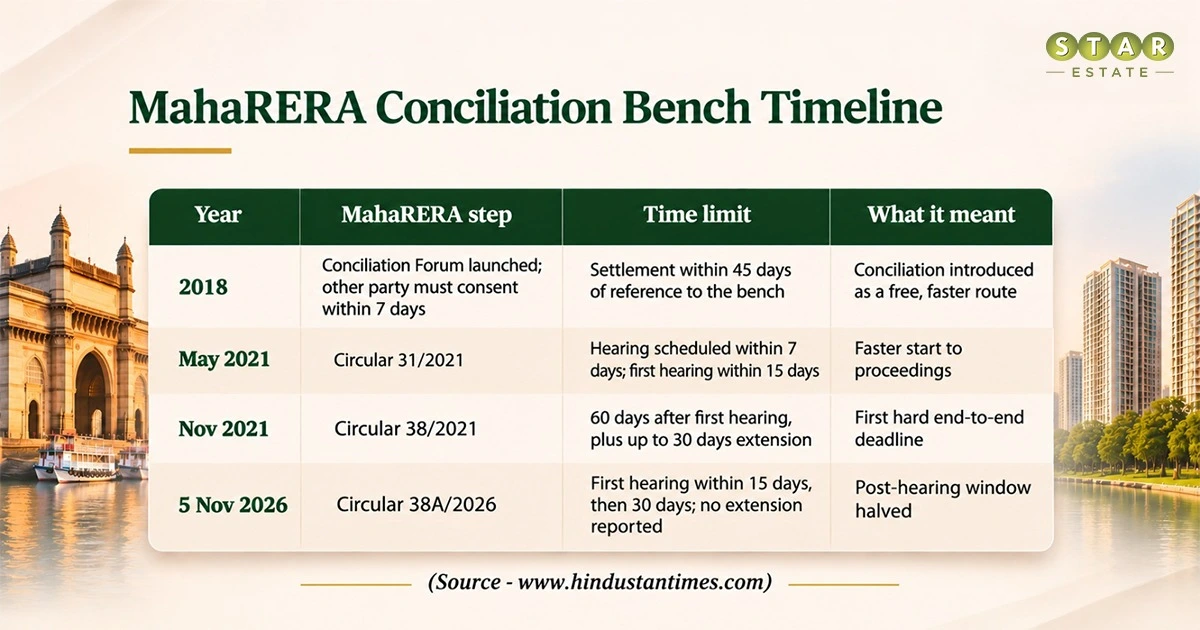
A note on this table: we have tracked the rule changes rather than price data, because that is what this news is about. Read it top to bottom and the direction is clear. Every revision has shortened the wait, and the latest one makes MahaRERA conciliation the quickest official route for homebuyers who want a negotiated outcome. In real estate disputes, time is money, especially when a home loan EMI is running on a flat you cannot move into. Use our EMI Calculator to see what a delay is really costing you.
What Do You Need to Know About MahaRERA Conciliation Bench?
The 30-day number is the easy part of the story. These are the details that decide whether it works for you.
The Developer Has to Say Yes First
Conciliation is not compulsory. One party files online, and the other must agree to take part. In an early reporting period cited by PropNewz, only 135 of 264 requests received developer consent, and 69 cases concluded amicably. The same source puts the success rate at around 79 percent where both sides consented. So the 30 days only matters once the developer is at the table.
Thirty Days Is Not the Whole Journey
Add the 15 days to the first hearing and you get roughly 45 days from assignment to a result. That is our arithmetic from the circular's two limits, and it compares with up to 105 days under the old rules. It does not include the time to get consent or for the complaint to be assigned. If conciliation fails, the matter goes back to MahaRERA for regular adjudication.
No Extension Means Preparation Is Everything
Under the old rules, a bench could ask for 30 extra days when a deal was close. Reports on the new circular do not mention that safety valve. If it is truly gone, both sides will need firm numbers and authority to agree on the spot. A 2021 industry expert quoted by Square Feat India said developers had earlier used adjournments to buy time when no deadline existed.
It Costs Nothing Extra and Can Be Enforced
When MahaRERA refers a matter, there is no separate fee for the conciliators, because MahaRERA bears that cost. A settlement recorded by MahaRERA after the forum's proceedings carries the force of an enforceable order, according to PropNewz. Reports on the forum's revised norms add that complainants' advocates can attend the proceedings.
The Backlog Is the Real Reason
Free Press Journal's Consumer Connect column notes that, given the pile of pending complaints, MahaRERA itself nudges complainants towards conciliation. A shorter window frees up hearing capacity. It also fits a wider pattern: in November 2025, MahaRERA issued an SOP giving developers 60 days from the date of an order to pay compensation, as reported by Business Standard.
Questions Still Open
The reports we reviewed do not say what happens if parties are one signature away at day 30. They also do not say how complaints already in conciliation before 5 November are treated. If either affects you, ask MahaRERA or your lawyer before you rely on the timeline.
Why Should Homebuyers Care About the MahaRERA Change in 2026?
Quick relief: A refund, interest, or possession date could be settled within weeks, not years.
Lower cost: No conciliator fee when MahaRERA refers the matter, and a lawyer may attend.
Less room to stall: A fixed clock leaves little space for adjournment tactics.
A stronger hand if you are prepared: Buyers with clean paperwork and a clear demand can use the short window.
An enforceable result: A recorded settlement has the force of an order, so it is not just a handshake.
A way around the backlog: The regulator itself suggests trying conciliation.
How to Prepare for a 30-Day Conciliation Hearing in Maharashtra
This is general information, not legal advice. Talk to a qualified lawyer about your own case.
Agreement for sale and payment record: Receipts, demand letters, bank statements and loan disbursal details.
Possession timeline: The date promised in the agreement, the date registered with MahaRERA, and the delay so far.
Communication trail: Emails, WhatsApp chats and letters to the developer.
One clear ask: Refund with interest, a firm possession date, or compensation. Put the amount in writing.
Your walk-away point: Decide the minimum you will accept before the first hearing, not during it.
Written terms: Make sure any settlement is recorded and that you get a copy.
Not sure what your flat is worth today, or what a refund should look like? Our property valuation tool and government schemes guide can help you set a realistic number.
Real Estate News 2026: What MahaRERA's Move Signals for Developers
For developers with clean books, a 30-day deadline is good news. It is a chance to close complaints cheaply and protect their MahaRERA record. For those who gained from delay, the margin for it is narrowing.
Recent MahaRERA orders show the same tightening. In November 2026, the authority ordered handover of two Vasai flats within 60 days and rejected pandemic-era excuses, as reported by Free Press Journal. In September 2026, it told Piramal Realty's PRL Developers to reconcile accounts for seven Revanta buyers in Mulund within 30 days.
For buyers, the lesson is simple. Check a developer's complaint history on the MahaRERA website before you book, and use our Reality Check Before Buying checklist alongside it. If you are tracking fresh supply, explore Star Estate's new launches and commercial properties.
MahaRERA Conciliation across Mumbai, Thane, Navi Mumbai, and Pune
When Maharashtra became the first state to start RERA conciliation in 2018, benches were set up in Powai, Thane, and Navi Mumbai, with Pune's bench at the MahaRERA office in Aundh. Check for real time locations, Star Estate is not responsible for relocations. Recent orders show how widely disputes spread: Mulund in Mumbai, Vasai in Palghar district, and Hinjawadi in Pune, where MahaRERA ordered conveyance of two Bloomville buildings within 60 days on 13th November 2026.
Comparing projects in these micro-markets? Start with our Buyer Guide and residential project listings. Living abroad and buying in Maharashtra? Our NRI investment guide covers the basics.
What to Expect from MahaRERA Conciliation Over the Next 12–24 Months
Complaints referred from 5th November onwards will start reaching their 45-day mark in the coming weeks, so early outcomes should be visible by early 2027. The numbers to watch are how many referred cases get developer consent and how many end as settled versus failed. We would also watch whether other state regulators study this timeline. Those are expectations, not facts, and we will update this blog when MahaRERA publishes data.
Talk to Star Estate Before You Book or Escalate
Whether you are a first-time buyer checking a launch, an investor weighing a resale, or a homebuyer stuck in a delayed project, a clear head and the right paperwork make all the difference. Star Estate's advisors can walk you through RERA registration checks, your payment plan and your options before you commit. Read more about Star Estate or browse our FAQs, then contact us or fill in the enquiry form for a free, no-obligation consultation.